Navigating Regulatory Uncertainty When Sourcing Novel Nutraceutical Ingredients
Overview
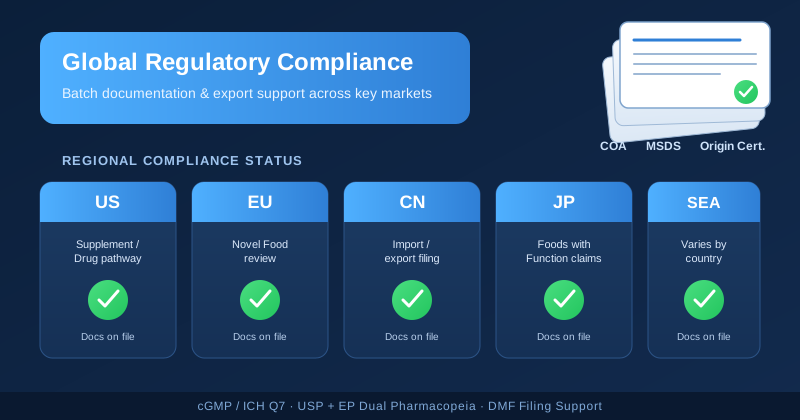
For buyers sourcing NAD+ precursors, novel peptides, and other emerging actives, regulatory classification uncertainty is often harder to manage than the manufacturing process itself. The same ingredient can be treated as a dietary supplement ingredient in the US, fall under Novel Food authorization in the EU, and require an entirely different registration or filing path in China, Japan, or Southeast Asia. This fragmented landscape, combined with suppliers who can't produce full documentation on demand, is the root cause behind shipments held at customs and, in worse cases, enforcement action.
Why the Regulatory Landscape Is So Fragmented
There is no single global standard for classifying ”novel” ingredients. The same active can simultaneously fit the definition of a dietary supplement, a pharmaceutical API, or a cosmetic active, depending on the target market's regulatory framework and submission pathway. NAD+ precursors are a good example: classification in several major markets is still evolving, and a one-time search rarely produces a conclusion that stays valid indefinitely.
Buyers also typically have to satisfy both export-country and import-country requirements at once — certificates of origin, phytosanitary certificates, customs-ready invoices — and the exact format and content expected varies by country. A single missing document can be enough to hold a shipment at the border.
Compliance Gaps That Often Get Overlooked
Many smaller raw-material suppliers can't produce a complete, batch-specific COA, MSDS, and heavy-metal/microbial report on request. When a buyer's local regulator or customer asks for verification, that documentation often has to be produced retroactively, delaying delivery. Ingredients without dual pharmacopeia certification, such as USP/EP, are also harder to defend during regulatory scrutiny or customer audits, since there's no independent, internationally recognized quality reference to point to.
How PathGene Reduces This Risk
PathGene maintains a complete, batch-level documentation package across all 38 SKUs — COA, MSDS, spec sheets, HPLC and heavy-metal/microbial reports, non-GMO and allergen declarations, and certificates of origin — and can assist with technical dossiers or DMF filing support when buyers need them. Flagship products including NMN and CDP-Choline carry dual USP and EP certification, giving buyers a stable, internationally recognized quality anchor that holds up regardless of how ingredient-specific classification rules shift.
With experience supporting regulatory submissions in the US, EU, Japan, and Southeast Asia, and export operations spanning 50+ countries, we can provide practical documentation support for customs clearance and inspection requirements — reducing the risk of delays caused by incomplete paperwork.
What Buyers Should Still Confirm Themselves
To be clear: PathGene provides supporting documentation and export experience, not legal advice. Regulatory classification for novel actives can change, and buyers should always confirm current requirements with regulatory counsel in their target market before finalizing a product's positioning or filing pathway.
Conclusion
Regulatory uncertainty can't be eliminated entirely, but working with a supplier that offers complete documentation, dual pharmacopeia certification, and real export experience meaningfully reduces execution risk. To learn more, browse our product catalog or contact us for a quote and sample batch documentation.
Ready to evaluate our products?
Request a sample or send an inquiry — our R&D team responds within 24 hours.