
Purity & Quality Control: Why It's Hard, and How PathGene Solves It
Overview
Purity and quality control are two of the hardest problems in synthetic biology manufacturing. Batch-to-batch variability, trace solvent or heavy-metal risk, and the difficulty of proving a purity claim to a skeptical B2B buyer are not signs of a bad supplier — they are structural challenges built into how these ingredients are made and tested industry-wide.
Impurity Profiles Are Set by the Synthesis Route, Not Just Final Polishing
Many manufacturers treat purity as something to fix at the end: synthesize first, then recrystallize or chromatograph until the number looks good. But the types and amounts of impurities present are largely determined by the synthesis route itself. Downstream polishing can remove some known impurities, but it cannot eliminate byproducts that are inherent to the chemistry chosen upstream. That is why two ingredients both labeled ”99% purity” can have very different real-world impurity profiles.
A Single HPLC Number Isn't Proof
Buyers are often handed one chromatogram and one percentage, with no visibility into the test method, the reference standard used, or whether the normalization approach is appropriate. The same batch tested with a different HPLC method or detection wavelength can yield a noticeably different ”purity” figure. Without full method transparency, a single number is a weak basis for a sourcing decision.
Heavy-Metal and Microbial Risk in Fermentation- and Synthesis-Derived Actives
Whether an active is produced by fermentation or chemical synthesis, it carries inherent risk of heavy-metal residues (lead, arsenic, cadmium, mercury) and microbial contamination (total aerobic count, yeast/mold, E. coli, Salmonella). For pharma-grade APIs and dietary supplement ingredients, these risks translate directly into finished-product compliance and safety. Without systematic per-batch testing, they can go undetected until it's too late.
How PathGene Builds Quality In From the Start
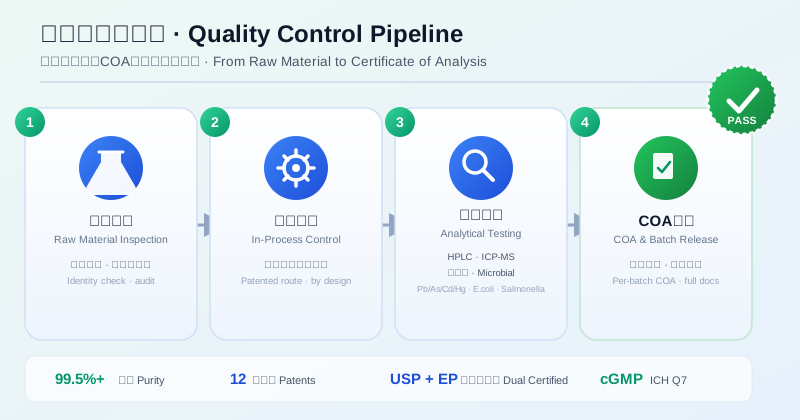
PathGene's founder brings direct quality-engineering experience from Pfizer, applying pharmaceutical-grade QA methodology to every production batch — moving quality control upstream into process design rather than relying solely on end-of-line testing. The company holds 12 granted core invention patents on its synthesis routes, which lets us control impurity profiles by design rather than by trial-and-error purification. Our flagship products (NMN, CDP-Choline) carry dual USP and EP pharmacopeia certification, a distinction still uncommon among Chinese manufacturers.
Every batch ships with a full third-party Certificate of Analysis (COA), and we make available MSDS, spec sheets, HPLC chromatograms, heavy-metal reports, microbial reports, and non-GMO/allergen statements on request. Our standard test panel covers appearance, identity/purity (HPLC normalization method), particle size, loss on drying/sulfated ash, heavy metals (Pb, As, Cd, Hg via ICP-MS), total aerobic count, yeast/mold, E. coli, and Salmonella — so buyers get a verifiable data chain, not a marketing claim. Third-party testing confirms our purity consistently exceeds 99.5%, versus an industry average closer to 98.5%.
Conclusion
Purity and quality control are hard precisely because they require discipline at three levels — process design, test methodology, and documentation transparency — not a single reassuring test report. To learn more, browse our product catalog or contact us for a quote and full batch documentation.
Ready to evaluate our products?
Request a sample or send an inquiry — our R&D team responds within 24 hours.