Complex Synthesis, High Cost, Low Yield: How PathGene's Enzymatic Fermentation Platform Solves It
Overview
Scaling up production of NAD+ precursors, coenzymes, and other bioactive ingredients keeps running into the same structural problem: synthesis routes are complex, costs are high, and yields are low. This isn't a plant-management issue — it's a built-in limitation of conventional multi-step chemical synthesis. PathGene designed its production platforms around a different premise: replace most chemical steps with enzymatic catalysis and fermentation, which changes the underlying cost structure rather than just optimizing around it.
Why Traditional Chemical Synthesis Is Expensive and Low-Yielding
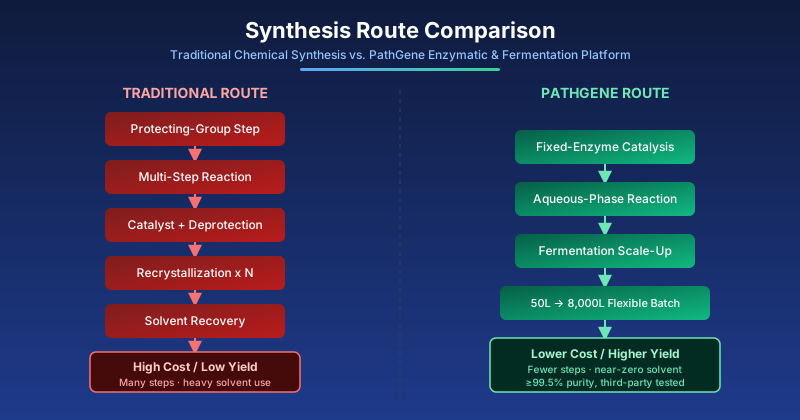
Multi-step organic synthesis often requires protecting groups to shield reactive functional sites from side reactions, then removing them later. Every protection/deprotection cycle adds another yield loss and another purification step. Metal catalysts, such as those used in hydrogenation, are costly and require careful recovery or replacement cycles.
The bigger cost driver is purification. Most chemical routes rely on repeated recrystallization, column chromatography, or extraction to reach pharmaceutical-grade purity — each separation step means material loss, solvent consumption, and a longer production cycle. Heavy organic solvent use also brings solvent recovery, waste treatment, and compliance costs that rarely show up in headline ”theoretical yield” figures but drive up the final quoted price.
Enzymatic Catalysis and Fermentation: Structurally Fewer Loss Points
PathGene's Enzymatic & Fermentation Platform uses fixed-enzyme catalysis alongside multi-strain fermentation — Lactobacillus, Hyphomicrobium, and recombinant E. coli — to replace multi-step organic synthesis with an aqueous-phase reaction system. Because enzymes are highly selective, they can act precisely on target sites without protecting groups, which cuts the number of synthesis steps and the yield loss that comes with each one.
The aqueous-phase system is the key structural change: reactions use almost no organic solvent, which lowers raw material costs and removes the hidden expense of solvent recovery and waste treatment. This Fermentation & Bioconversion Platform has proven this approach at scale for products like GABA, PQQ, and S-Equol.
From 50L to 8,000L: Scaling Without Sacrificing Purity
Fermentation offers another structural advantage: flexible scale-up. PathGene's fermentation systems scale from 50L to 8,000L without redesigning the chemistry for each batch size. Production runs in a 1,500m² clean facility in Nanjing under cGMP and ICH Q7 requirements, with quality engineering practices shaped by the founder's background at Pfizer — turning ”scale without compromise” into an actual operating standard rather than a slogan.
Conclusion: The Route You Choose Sets Your Cost Ceiling
Complex synthesis, high cost, and low yield are ultimately a question of route selection, not an industry ceiling that can't be broken. PathGene holds 12 granted invention patents on its core synthesis routes, and third-party testing shows flagship product purity consistently above 99.5% — roughly one percentage point above the industry average — with NMN and CDP-Choline both certified to USP and EP pharmacopeia standards. To learn more, browse our product catalog or contact us for a quote.
Ready to evaluate our products?
Request a sample or send an inquiry — our R&D team responds within 24 hours.